Architecture and Design
Tip
It is expected that the How it Works Guide were read and understood.
Smart Geocubes is built around a procedural download workflow:
the local Zarr store is treated as a product in its own right, and the library only fills in missing parts on demand.
The libraries design goals are user-orientated - the user should be able to:
- open the datacube even without this library once downloaded via XArray or Icechunk (Zarr).
- easily add new datasets from supported remote sources
- add support for new / own remote sources
The architecture is split into three layers:
- Specific dataset accessors
- Remote source adapters
- Storage
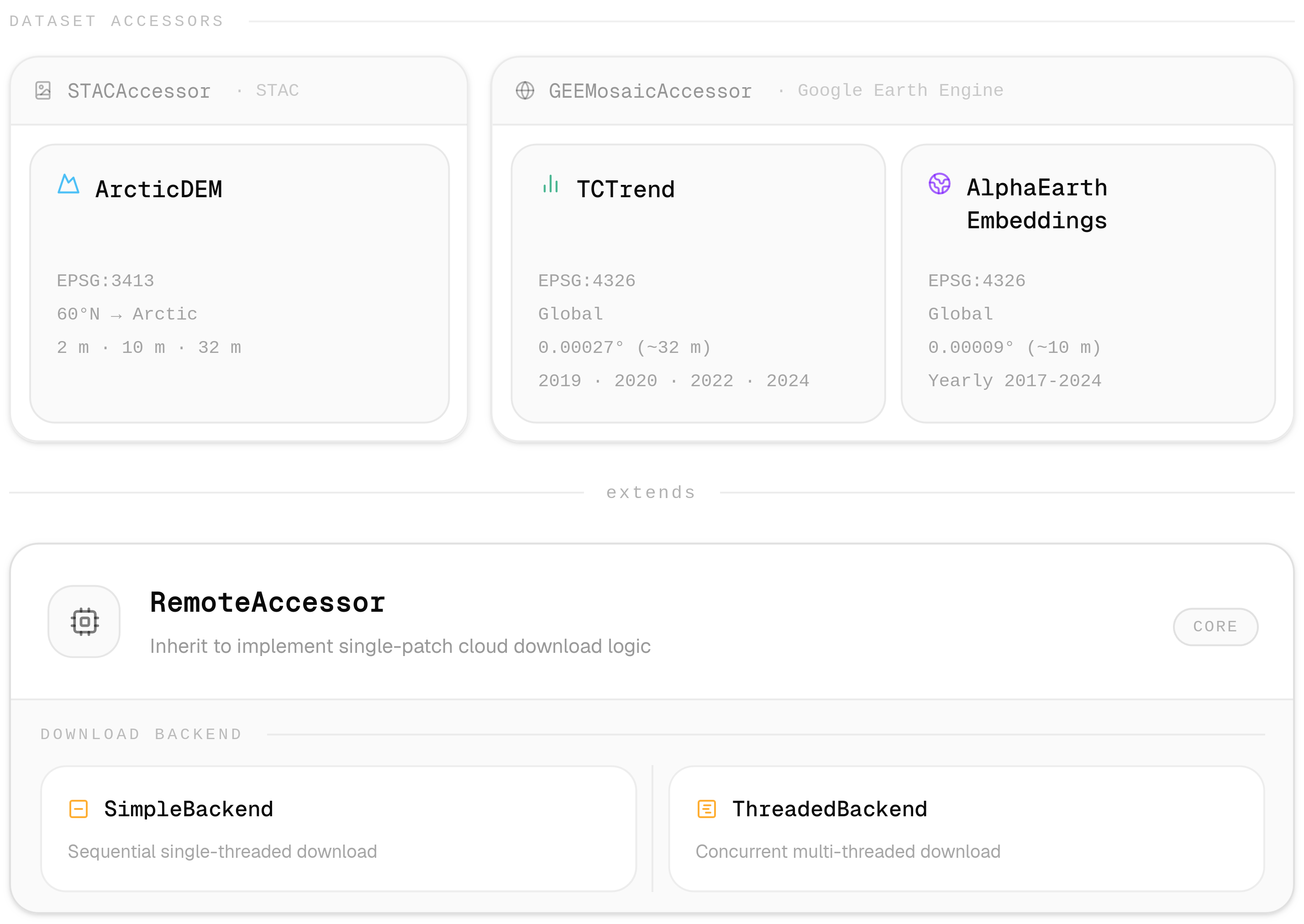
The lowest level, the storage abstraction, is the core of the library.
At its heart is a RemoteAccessor abstract base class which contains most logic.
It utilizes one of the two DownloadBackends, SimpleBackend and ThreadedBackend, which orchestrate the downloading and writing of patches / tiles.
Source dependent accessors inherit from RemoteAccessor and define how a patch / tile is downloaded from the remote.
Then dataset specific accessors further inherit from these source dependent accessors specifying the dataset's configuration and metadata.
Loading a partially downloaded region
Once the user wants to load() a specific region of a dataset, logic defined in the RemoteAccessor ABC uses the source specific accessor to check which patches / tiles are adjacent to the region of interest.
If all adjacent patches are already contained in the local datacube, the datacube will be opened at the region of interest.
Otherwise, the RemoteAccessor requests its DownloadBackend to download the missing patches, which call the source specific accessors download function.
The SimpleBackend iterates over the requested patches, downloads and then writes them one by one.
A more efficient approach is utilized by the ThreadedBackend, where multiple patches are downloaded and written in parallel.
The diagram below shows this common control flow.
sequenceDiagram
    autonumber
    actor User
    participant RemoteAccessor
    participant Backend as DownloadBackend
    participant SourceAccessor
    participant Source as Remote source
    participant Store as Icechunk / Zarr via Xarray

    User->>RemoteAccessor: calls load(aoi, toi, persist, create)
    RemoteAccessor->>SourceAccessor: adjacent_patches(aoi, toi)
    SourceAccessor-->>RemoteAccessor: adjacent_patches
    RemoteAccessor->>RemoteAccessor: new_patches = adjacent_patches - loaded_patches

    opt Missing patches exist
        RemoteAccessor->>Backend: submit(new_patches)

        alt SimpleBackend
            loop each missing patch
                Backend->>SourceAccessor: download_patch(idx)
                SourceAccessor->>Source: Source specific download logic
                Source-->>SourceAccessor: patch_dataset
                SourceAccessor-->>Backend: patch_dataset
                Backend->>Store: write_patch(patch_dataset)
            end
        else ThreadedBackend
            loop each missing patch
                Backend->>Backend: put patch on download_queue
            end
            par download workers
                Backend->>SourceAccessor: download_patch(idx)
                SourceAccessor->>Source: Source specific download logic
                Source-->>SourceAccessor: patch_dataset
                SourceAccessor-->>Backend: patch_dataset
                Backend->>Backend: put patch on write_queue
            and writer thread
                Backend->>Store: write_patch(patch_dataset)
            end
        end

    end

    RemoteAccessor->>Store: Lazy-Open Zarr
    RemoteAccessor->>RemoteAccessor: Crop to region of interest
    opt persist = True
        RemoteAccessor->>Store: Load data into memory
    end
    RemoteAccessor-->>User: return dataset for requested region