Download Backends
Tip
It is expected that the How it Works Guide and Architecture pages were read and understood.
Whenever load() finds patches / tiles that are not yet in the local datacube, it hands them off to a DownloadBackend.
The backend is responsible for downloading the missing patches from the source and writing them into the Zarr datacube.
Smart-Geocubes ships two implementations, SimpleBackend and ThreadedBackend, which trade simplicity for throughput.
You select the backend when constructing an accessor:
import smart_geocubes

# Uses the default backend ("threaded")
accessor = smart_geocubes.ArcticDEM32m("datacubes/arcticdem_32m.icechunk")

# Explicitly pick a backend
accessor = smart_geocubes.ArcticDEM32m("datacubes/arcticdem_32m.icechunk", backend="simple")
SimpleBackend
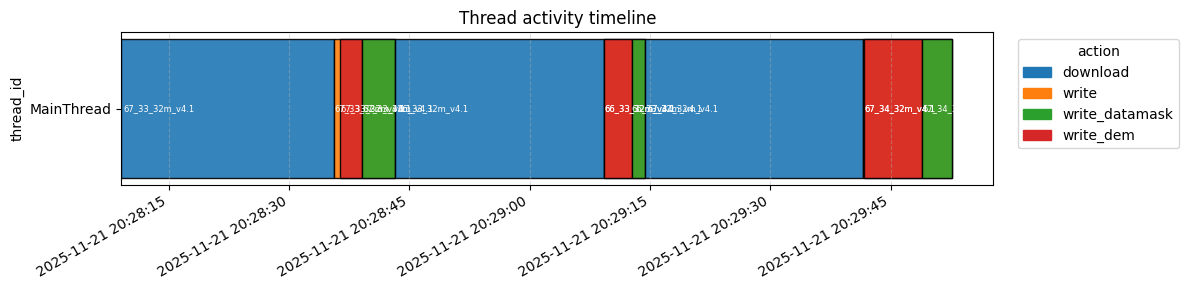
SimpleBackend processes patches strictly one after another: for each patch it downloads the data, then writes it to the Zarr store, then moves on to the next patch.
Everything happens on a single thread, so there is no concurrency to reason about, which makes it the easiest backend to debug and the safest choice in a multiprocessing environment (e.g. one ProcessPoolExecutor worker per region), where each process already gets its own backend instance.
It also has no minimum Python version requirement.
The Gantt chart below shows a SimpleBackend run downloading and writing three patches: the single MainThread alternates between one long download bar and short write / write_datamask / write_dem bars, one patch at a time, with no overlap.
ThreadedBackend
ThreadedBackend decouples downloading from writing so both can happen concurrently:
- Downloads: a pool of downloader threads (
concurrent_downloads, default4) fetches multiple patches from the source in parallel. - Download→write buffer: a bounded queue (
maxsize=2) sits between the download pool and the writer thread. Once 2 completed-but-unwritten patches are buffered, further finished downloads block until the writer catches up — so downloads can get at most 2 patches ahead of writing. - Writes: a single writer thread handles one patch at a time, but fans out that patch's per-variable writes to a pool of 4 workers, so multiple variables of the same patch (e.g. a DEM's
demanddatamask) are written concurrently. - Writes are retried up to 100 times on
icechunk.ConflictError(concurrent commits from other writers), and downloads are retried up to 5 times on failure.
This backend requires Python 3.13 or newer, since it relies on queue.Queue.shutdown() to tear down the write queue cleanly. Constructing an accessor with backend="threaded" (the default) on an older Python raises NotImplementedError; use backend="simple" if you're on Python 3.12 or need multiprocessing-safe behavior.
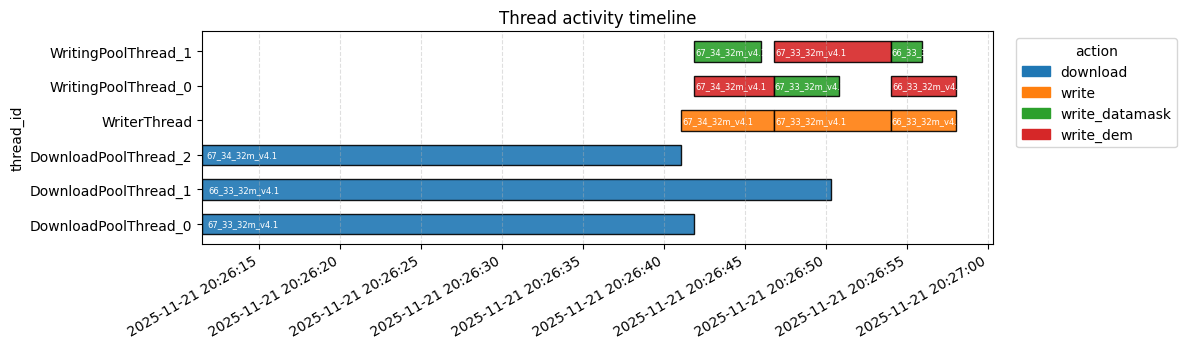
The Gantt chart below shows the same three-patch workload as above, but on ThreadedBackend: three DownloadPoolThreads run in parallel, and the WriterThread dispatches overlapping write_dem / write_datamask work to WritingPoolThread_0 / WritingPoolThread_1 as soon as each download finishes. The whole batch completes in roughly half the wall-clock time of the SimpleBackend run.
Which one should I use?
ThreadedBackend is the default and the recommended choice for most workloads: it has proven stable and gives higher download throughput by overlapping network I/O with disk writes.
Prefer SimpleBackend when you need deterministic, easy-to-debug behavior, when you're distributing work across processes rather than threads, or when you're stuck on Python 3.12.